

A Commercial EICR is the standard inspection and testing report used to assess the condition of the fixed electrical installation in business premises. In simple terms, it is the recognised way to evidence that the fixed wiring in a commercial property has been inspected, tested, recorded and reviewed for safety.
Commercial properties must keep electrical systems safe and maintained to prevent danger. The legal duty for workplaces and commercial premises is broader than “get an EICR every X years”. Under the Electricity at Work Regulations 1989, systems must be of such construction and maintained so as to prevent danger, so far as is reasonably practicable. In practice, an EICR is the standard report businesses use to evidence that duty for insurers, audits, lease compliance and internal health and safety management.
If you manage a shop, office, warehouse, restaurant, school, industrial unit, surgery, care setting or mixed-use building, this guide explains what a commercial EICR is, when it is usually needed, who is responsible, how often it is typically done, what the inspection covers, and what happens if the report is unsatisfactory.
Last updated: 2026
Reviewed By: London Safety Certificate Compliance Team
Key Takeaways
- A commercial EICR is the standard report for the fixed electrical installation in business premises.
- The legal duty is to maintain electrical systems to prevent danger; the law does not set one single inspection interval for every commercial property.
- In practice, businesses use an EICR to evidence compliance for insurers, leases, audits, facilities management and risk control.
- Responsibility depends on control of the installation and the lease, not just on who owns the building.
- The next inspection date should be risk-based and recommended by a competent person.
- A good compliance pack should include the latest EICR, remedial evidence, certificates, past reports and any limitations recorded.
Table of Contents
Do Commercial Properties Need an EICR?
In practice, most commercial properties do need periodic inspection and testing as part of electrical safety maintenance. Fixed wiring does not stay perfect forever. Heat, load, age, vibration, moisture, poor alterations, lack of maintenance and environmental conditions all affect the condition of the installation over time. That is why a commercial EICR is so widely used in real business settings.
A business will commonly need an EICR when:
- an insurer asks for evidence of electrical maintenance
- a managing agent or compliance team asks for the latest report
- a lease is being granted, renewed or reviewed
- there has been a major fit-out or change of occupancy
- there has been an incident such as overheating, repeated tripping, water ingress or fire
- the previous report’s recommended next inspection date is due
So while not every premises owner asks the question in the same way, the practical answer is simple: if you control a commercial installation, you normally need a plan to inspect, test, record and maintain it properly. See the full explanation of UK rules and how ‘legal requirement’ works in practice.
Is an EICR a legal requirement for commercial property?
The legal duty for commercial premises is not normally written as “you must get an EICR every X years”. The legal duty is broader: electrical systems must be constructed and maintained to prevent danger. That comes from the Electricity at Work Regulations 1989.
That means the real legal question is not just “Is an EICR mandatory?” but “How do you prove you are maintaining the fixed electrical installation safely?” In practice, the answer is usually an EICR, because it provides a recognised written record of:
- inspected and tested fixed wiring
- results and observations
- defects requiring action
- a recommended next inspection date
This is why EICRs become “effectively mandatory” in practice through:
- insurance conditions
- lease clauses
- health and safety audits
- facilities management standards
- contractor and corporate compliance processes
If you want the legal side explained in more detail, read is an EICR a legal requirement for commercial property.
Fixed wire testing vs EICR vs PAT testing (don’t mix these)
These are often mixed up, and they should not be.
Fixed Wire Testing
This is the inspection and testing of the fixed electrical installation.
EICR
This is the report produced from that fixed wire inspection and testing.
PAT Testing
This relates to portable electrical equipment such as kettles, monitors, extension leads and portable tools. It is separate from the EICR and does not replace fixed wiring inspection. HSE’s guidance on portable equipment makes clear that maintenance needs depend on the equipment, environment and prior results, which is a separate question from the condition of the fixed installation.
In short:
- EICR / fixed wire testing = building wiring and fixed installation
- PAT testing = portable appliances
A business can need both, but they are not the same job.
Who is responsible for EICR on commercial property?
Responsibility depends on control and the lease, not just on title ownership.
Typical landlord responsibilities
These often include:
- main intake position
- landlord switchgear and risers
- base building wiring and common parts
- landlord supplies (lighting in common areas, plant serving whole building)
Typical tenant responsibilities
These often include:
- wiring serving tenant-only demised areas
- tenant fit-out installations
- local distribution boards within the demise
- supplies to tenant equipment or machinery where included in the lease
Practical rule (simple):
If you control the installation, you are normally the one expected to keep it safe and to evidence maintenance.
This is why commercial sites often need someone to review the lease carefully before booking the inspection. A lot of confusion comes from people assuming “owner” and “responsible party” are always the same. In commercial property, they often are not. For a more detailed landlord-vs-tenant breakdown, see who is responsible for EICR on commercial property.

Commercial EICR frequency (how often should it be done?)
There is no single legal interval for all commercial premises. HSE guidance focuses on maintenance to prevent danger, while IET guidance states that the interval for inspection and testing is recommended by the designer initially and by the competent person thereafter, taking account of the installation, its use, and maintenance history. That means commercial EICR frequency is risk-based, not one-size-fits-all.
The next inspection date will normally depend on:
- type of premises
- load and usage
- age and condition of the installation
- environment, including heat, dust, moisture or vibration
- number of alterations and fit-outs
- maintenance quality
- previous EICR findings and defect history
- whether the site is open to the public or subject to licensing conditions
Premises with heavier use, harsher environments, frequent alteration work or more safety-critical systems will often need shorter intervals than lower-risk office-type environments.
The clean rule is this:
Follow the recommended next inspection date on the last EICR unless a competent person advises otherwise. If you want the interval question covered separately, read how often should EICR be carried out on commercial property.
When Should You Arrange a Commercial EICR Sooner?
Do not wait passively for a calendar date if the premises has changed materially.
Arrange an EICR sooner if:
- there has been flood, fire or major water ingress
- the building has had a significant fit-out or reconfiguration
- there is repeated tripping, overheating or unexplained faults
- there has been a change in use of the premises
- you are taking on or handing over a lease
- your insurer, auditor or client requires updated evidence
- the previous report had important limitations that need closing out
A commercial EICR is not just a routine job. It is also a control point after change, damage or risk escalation.
Commercial EICR cost (what affects price?)
Commercial EICR cost is mainly driven by:
- number of distribution boards and circuits (bigger = more test time)
- access and shutdown arrangements (no shutdown = more limitations/return visits)
- complexity (three-phase systems, plant rooms, multi-tenant sites)
- condition of installation (older systems take longer to test/record)
- site readiness (blocked DBs, no keys, no permits = delays)
What to do to keep costs down (practical):
- clear access to DBs/switchgear
- provide keys/permits for risers/plant rooms
- agree a shutdown window in advance
- provide previous EICR and known issue history

What Does a Commercial EICR Cover?
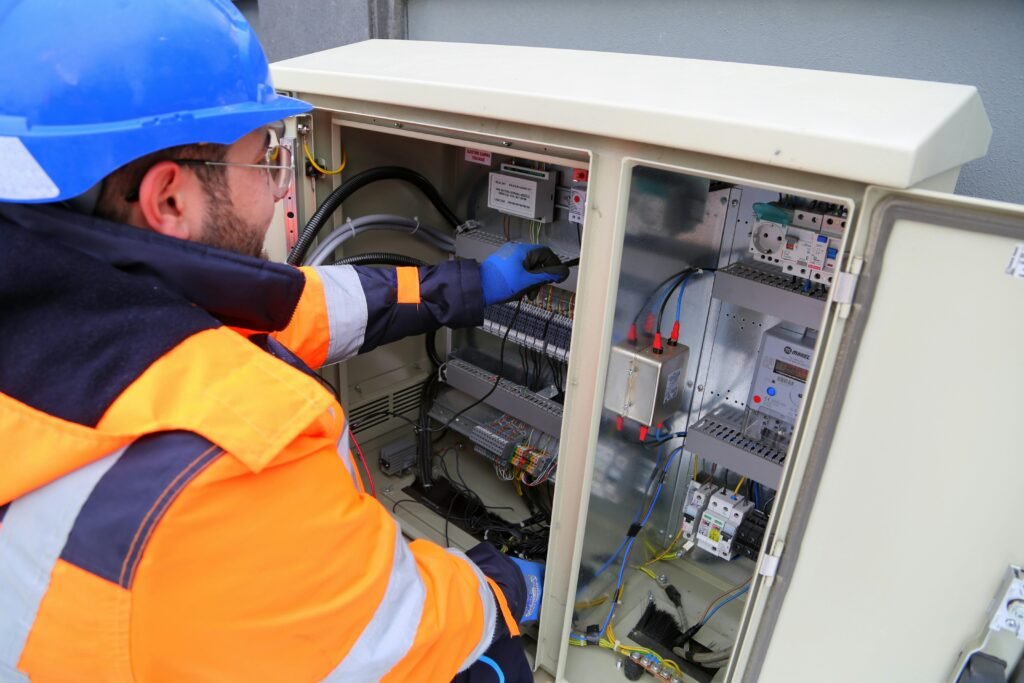
A commercial EICR focuses on the fixed installation, typically including:
- intake position and isolators
- switchgear and distribution boards
- earthing and bonding arrangements
- protective devices (RCDs/RCBOs where applicable)
- circuits serving lighting, socket outlets and fixed equipment
- visible signs of overheating, deterioration, loose terminations or damage
- recorded test results and coded observations
The goal is not just to look around. It is to assess whether the installation is in a satisfactory condition for continued service and whether there are safety issues that need to be addressed.
See the EICR test procedure (what’s actually tested).
What a Commercial EICR Does Not Cover
A commercial EICR does not replace:
- PAT testing
- gas safety checks
- fire risk assessments
- servicing schedules for specialist machinery
- manufacturer maintenance requirements
- every other compliance document on site
This matters because many site managers wrongly assume “we passed the EICR, so all electrical compliance is done”. It is not. The EICR is one key part of the electrical safety picture, not the whole compliance stack.
EICR for Different Business Types
Understanding the specific needs of different business types is key when considering the frequency and focus of Electrical Installation Condition Reports (EICRs). The diverse operational environments and varying electrical demands necessitate a tailored approach to ensure both compliance and safety. For instance, a manufacturing plant with heavy machinery differs significantly from a small retail boutique in terms of electrical load and risk factors.
To illustrate, here is a breakdown of how EICR requirements can vary by business type:
| Business Type | Typical Risks | Recommended EICR Frequency |
|---|---|---|
| Manufacturing | High – heavy machinery usage | Every 3 years |
| Retail | Moderate – constant customer flow and electronic equipment use | Every 5 years |
| Office Environments | Low – standard office electronics and lighting | Every 5 years |
What happens if the EICR is unsatisfactory?
If the report has certain observation codes, remedials/further investigation are required.
Common EICR codes:
- C1 danger present (immediate action)
- C2 potentially dangerous (urgent action)
- C3 improvement recommended
- FI further investigation required
A report containing C1, C2 or FI is unsatisfactory. C3 on its own does not make the report unsatisfactory. That means some findings need urgent remedial work, while others are advisory improvements. This matters because a business needs to distinguish between issues that stop the installation being satisfactory and issues that should still be improved but are not immediate fail points.
If the EICR is unsatisfactory, the next step is usually:
- review the observations properly
- prioritise urgent defects
- arrange remedial work or further investigation
- keep evidence of the work completed
- update the compliance file
What documents you should keep (compliance pack)
A proper commercial electrical compliance pack should include:
- latest EICR report + schedules
- remedial evidence
- relevant certificates such as EIC or MWC where applicable
- previous EICRs for trend/history
- distribution schedules or single-line information if available
- maintenance records
- any limitations and follow-up notes
- proof of further investigation where FI items were raised
This is where many businesses fall down. They get the inspection done, but they do not keep the paperwork in a way that satisfies insurers, managing agents or auditors later.
How to prepare for a commercial EICR (avoid limitations)
Good preparation reduces limitations, delays and repeat visits. Before the visit:
- confirm whether shutdown will be needed
- clear access to distribution boards and switchgear
- arrange keys, permits and escorts for restricted areas
- identify known issues in advance
- confirm who can authorise access, shutdown or limitations on the day
If limitations occur (no access/no shutdown/no safe isolation), they must be recorded and often require a return visit. See our full Guide on Operational Limitation on EICR.
Frequently Asked Questions
Do commercial properties need an EICR?
In practice, most commercial premises need periodic inspection and testing as part of maintaining electrical safety. An EICR is the standard report used to evidence that for the fixed installation.
Is fixed wire testing the same as an EICR?
Almost always in normal business usage, yes. Fixed wire testing is the inspection and testing work, and the EICR is the report that records the outcome.
How often does a commercial property need an EICR?
There is no single legal interval for all commercial premises. The interval should be risk-based and recommended by a competent person.
Who is responsible for a commercial EICR: landlord or tenant?
It depends on lease terms and control of the installation. In practice, the party controlling the relevant part of the installation must be able to evidence maintenance and safety.
Does a commercial EICR cover portable appliances?
No. Portable appliances are a separate issue from the fixed installation.
Do we need to shut the building down?
Sometimes. Some tests require isolation. If shutdown isn’t possible, limitations may be recorded and a return visit planned.
What happens if the report is unsatisfactory?
Any C1, C2 or FI items need action. The findings should be reviewed, remedials or investigation arranged, and the paperwork retained properly.
Who can carry out a commercial EICR?
A competent person with appropriate inspection and testing knowledge, training and experience for commercial installations. The IET’s wording for competence focuses on adequate education, training, practical skills, and the ability to perceive risks and avoid hazards electricity can create. You can also read our guide on who can do a commercial electrical installation condition report.
Conclusion
Commercial property EICR requirements are not really about chasing one magic legal interval. They are about proving that the fixed electrical installation is being maintained safely, inspected properly and recorded in a way that stands up to insurers, audits, lease obligations and real-world risk.
For most businesses, the best approach is simple: follow the recommended next inspection date on the last report, prepare the site properly, keep the compliance pack in order, and act quickly if the report is unsatisfactory.