

To identify a fire door, look for a certification label on the top edge or side of the door, which details its fire resistance rating in minutes, such as FD30 or FD60. Additionally, check the door and frame for intumescent seals that swell under heat to block smoke and flames; these must be intact and correctly fitted. Verify that the door frame’s fire rating matches the door’s, as both components must meet safety standards to prevent the effective spread of fire. Inspecting these elements closely offers you a clearer understanding of their functionalities and maintenance requirements.
Key Takeaways
- Look for a certification label on the top edge of the door indicating the fire resistance rating and compliance details.
- Check for intumescent seals around the door edges and frame, ensuring they are intact and properly fitted.
- Confirm the presence of a fire-rated frame with a matching resistance rating to the door.
- Inspect the door for a minimum of three steel or brass hinges, properly spaced for optimal support.
- Verify that the door and its components comply with UK Building Regulations Part B, particularly in buildings with more than two storeys.
Table of Contents
How can you tell if a door is a fire door in the UK?
To determine if a door is a fire door in the UK, look for a certification label, typically located on the top edge of the door.
This label provides essential information, including the door’s fire resistance rating.
Additionally, check for intumescent seals around the door frame, which expand when exposed to heat, sealing off gaps to prevent the spread of fire and smoke.
Look for the certification label.
One reliable method for determining if a door is a fire door in the UK is to check for a certification label, typically located on the edge of the door. This label is vital as it indicates the door’s compliance with stringent certification standards.
You must understand that not just any label qualifies; it must detail specific performance criteria that have been met through rigorous fire door testing.
These labels provide a traceable link back to the manufacturer and outline essential data such as the door’s fire resistance rating, often quantified in minutes (e.g., 30, 60, 90 minutes). The placement of this label is standardised to guarantee visibility and durability under inspection procedures.
When examining a fire door, scrutinise the label for signs of tampering or inconsistency. Any discrepancies in label information or improper placement can suggest non-compliance with safety regulations.
Always verify that the door materials listed align with quality assurance frameworks, confirming they meet the required fire resistance capabilities.
Becoming familiar with these labels and their specifics isn’t merely about compliance it’s about safeguarding safety in environments vulnerable to fire hazards.
Each component, from material selection to final inspection, must adhere to established safety protocols, underscoring the essential nature of proper certification in fire safety management.
Check for intumescent seals.
Check the door’s edges and frame for intumescent seals to verify if it’s a fire door. These seals are vital for fire safety compliance and are designed to expand under high temperatures, sealing gaps to prevent smoke and flames from passing through.
Different intumescent seal types cater to varying levels of exposure and thermal expansion properties, which are important for maintaining the door’s integrity during a fire.
When evaluating a fire door installation, verify that the intumescent seals are correctly fitted according to building regulations and the manufacturer’s guidelines. The placement must be precise, as even minor misalignments can compromise the door’s effectiveness in smoke control and fire containment.
Regular maintenance is necessary to preserve the functionality of these seals. Over time, wear and degradation can diminish their effectiveness, necessitating periodic checks and replacements to meet maintenance requirements.
Additionally, adhere to the testing standards set by fire safety authorities to verify that these seals perform under the conditions for which they were designed.
Understanding these components and their proper implementation reinforces your mastery in fire door assessment and verifies adherence to stringent fire safety measures in building environments.
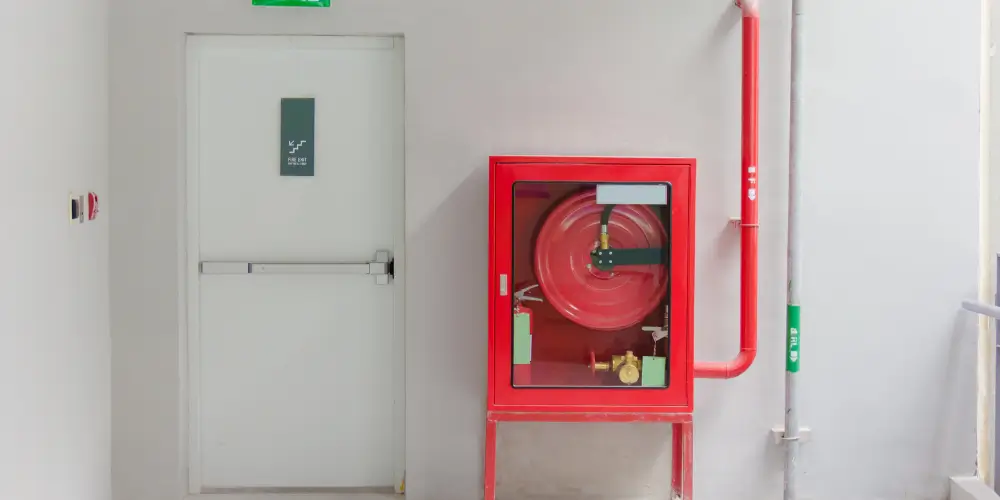
Fire Door Labels and Markings
You’ll typically find fire door labels on the hinge side, top, or occasionally on the door edge, vital for verifying compliance and safety standards.
These labels should display key information, including the manufacturer, fire resistance rating, and the date of manufacture, guaranteeing the door meets UK regulatory requirements.
You must check these labels regularly to confirm they remain legible and intact, as they’re fundamental to the door’s certification and functionality in preventing the spread of fire.
Location of labels, And What does a fire door label look like?
To accurately identify a fire door, observing the labels and markings is vital. You’ll typically find the label on the hinge side of the door or the frame, ensuring visibility during inspection. These labels are essential for verifying the door’s compliance with safety regulations and its alignment with specific fire door characteristics.
A standard fire door label contains detailed information about the door’s fire rating, indicating the duration the door can withstand fire exposure, usually noted in minutes or hours (e.g., 30, 60, 90, 120). The label design also includes the manufacturer’s identification, the certification mark of the testing agency, and, in some cases, a serial number for traceability. This data is fundamental to adhere to compliance standards and for accurate reference during safety inspections.
Moreover, the durability features of a fire door, such as resistance to warping and integrity under extreme temperatures, are implied by the fire rating and material specifications listed on the label.
You must ensure that label placement adheres to the inspection guidelines, as improper labelling can complicate maintenance checks and compromise the door’s intended safety function.
What are the requirements for labelling fire doors in the UK?
In the UK, specific regulations govern the labelling of fire doors to ensure maximum safety and compliance with national standards. You must familiarise yourself with these essential requirements to ensure your fire doors meet the necessary fire door standards and labelling regulations.
Each fire door should carry a permanent label indicating its fire resistance rating, typically ranging from FD30 to FD120, which denotes the number of minutes of fire resistance it offers. These labels are significant for compliance guidelines and must include the manufacturer’s name, the date of manufacture, and the specific door model. This information assists in both installation and future maintenance practices.
The labeling must be clear and durable, capable of withstanding the environments in which the doors are installed. This is fundamental not only for immediate safety certifications but also for routine inspection procedures.
Fire door labels should be easily visible and located on the top edge of the door or the hinge side to make certain they aren’t painted over or otherwise obscured during regular maintenance practices.
Adhering to these marking requirements and installation criteria helps maintain the integrity of fire safety measures, ensuring that all components are up to code and effective in protecting against fire hazards.

Check for Intumescent Seals
You should examine the edges of the door or its frame for intumescent seals, which are essential for enhancing the door’s fire resistance.
These seals are designed to expand considerably when exposed to high temperatures, effectively sealing any gaps to prevent the passage of smoke and flames.
Verify that these seals are intact and correctly installed to maintain the door’s integrity in the event of a fire.
Edge of the door or frame
Inspect the edges of the door or its frame for intumescent seals, a vital component in fire door assemblies. These seals play an important role in preventing smoke and flames from passing through the door edges during a fire. You’ll find that these seals are not just a safety feature but a compliance necessity.
Inspect the door construction closely. The frame material and edge thickness are key factors in the overall fire resistance of the door. Look for uniformity and any signs of damage that could compromise the door’s integrity.
| Feature | Details |
| Frame Material | Must be non-combustible or fire-rated |
| Edge Thickness | Minimum standards vary by regulation |
| Hinge Placement | Significant for maintaining alignment |
Ensure that seal installation meets standards by verifying compliance with testing standards and regulations. A properly installed intumescent seal should be continuous and without gaps. This precision in installation is essential for the door to perform effectively under fire conditions.
Expand when heated
Many fire doors feature intumescent seals that expand considerably when exposed to high temperatures, effectively blocking smoke and fire from spreading. You’ll need to understand this material behaviour and its essential role in the overall fire resistance of door systems.
Intumescent seals are a key component in fire door construction, designed to undergo significant thermal expansion. This reaction is crucial for heat absorption and smoke containment, thereby enhancing the door’s ability to compartmentalise fire. The seals expand to fill gaps between the door leaf and frame, preventing the passage of harmful smoke and flames.
To guarantee you’re dealing with a door that meets safety standards, look for these characteristics:
- Testing Certification: Search for labels indicating that the door and its components have undergone rigorous testing methods.
- Material Specifications: Check the seal’s composition to confirm it’s designed for high-performance under fire conditions.
- Visible Integrity: Inspect for any signs of damage or deterioration that might affect performance.
Understanding these aspects is imperative for maintaining the integrity of fire safety systems in buildings.
Always consult with safety experts or refer to detailed technical guidelines when evaluating fire doors for compliance and functionality.
Which Doors need to be Fire Doors in the UK?
In the UK, it is mandatory to install fire doors in all designated escape routes to ensure a safe exit in the event of an emergency.
These doors are also required between different risk areas to prevent the spread of fire and smoke, protecting both lives and property.
It’s crucial to comply with these regulations to meet safety standards and maintain the integrity of the building.

Required in escape routes
In the UK, certain doors must be designated as fire doors to enhance safety and provide essential protection in escape routes during emergencies.
You’ll find that the integration of fire doors is a fundamental aspect of escape route design, ensuring that in the case of a fire, the spread is contained and individuals have sufficient time to evacuate safely.
When planning the placement and specification of fire doors, several key factors must be considered:
- Building Codes Compliance: Adherence to UK building regulations Part B, which demands fire doors in all escape routes in buildings over two storeys.
- Risk Assessment Guidelines: A thorough assessment must identify areas of high risk and guarantee that fire doors are strategically positioned to mitigate these risks.
- Occupancy Load Considerations: The number of people the building accommodates determines the required fire resistance rating of the doors, which in turn affects both material choice and installation.
Mastering these elements is vital for effective emergency exit planning and evacuation strategy essentials.
Each fire door must comply with safety regulations, guaranteeing it meets the necessary standards for fire resistance and integrity.
Needed between risk areas
Several doors within your building need to be fire doors to separate areas with differing risk levels. Understanding the specifics of fire door construction and the materials involved is vital for ensuring safety compliance.
These doors are integral to maintaining the integrity of smoke control systems and must adhere to stringent fire resistance ratings as dictated by building regulations.
Fire doors equipped with appropriate door hardware, such as intumescent seals and automatic closing devices, are mandatory in areas prone to high fire risks, such as kitchens, boiler rooms, and storage areas containing flammable materials.
The construction of these doors mustn’t only resist the passage of flames but also limit the spread, thereby safeguarding evacuation routes and adjacent compartments.
It’s essential to adhere to prescribed fire door maintenance protocols to retain their protective qualities. Regular inspections and tests must confirm that the door’s integrity and functionality are uncompromised.
This includes checking the condition of seals, hinges, and the operation of self-closing mechanisms.
Does a Fire Door need a Certificate?
You may wonder if your fire door requires a certificate to ensure it meets legal and safety standards.
Indeed, a certificate is crucial as it confirms the door’s compliance with rigorous fire resistance criteria.
This certificate will list important details such as the door’s fire rating, manufacturing standards, and installation specifications.
Certification proves compliance
When installing a fire door, verifying that it meets all safety standards is essential, and this typically requires a certification. Certification isn’t just a piece of paper; it’s proof of compliance with stringent fire safety norms and installation guidelines.
Certification standards dictate the rigorous testing procedures these doors undergo before they’re deemed safe for installation. These standards ensure that every certified fire door can withstand specific conditions during a fire, providing critical protection and enabling safe egress.
To maintain this level of safety, you must adhere to precise compliance regulations. These regulations encompass:
Door
specifications
Detailed requirements for materials, thickness, and hardware compatible with fire resistance ratings.
Installation
guidelines
Procedures that must be followed to guarantee the door functions correctly in the event of a fire.
Maintenance requirements
Regular checks and upkeep are necessary to preserve the door’s integrity over time.
Adhering to these criteria through certification means you’re not just installing a door; you’re integrating a significant component of a building’s fire safety strategy.
What the certificate includes
Typically, a fire door certificate includes a thorough rundown of the door’s design, construction materials, and the specific fire resistance rating it has achieved through testing. The certificate details are significant as they confirm the door’s compliance with stringent safety and building regulations.
As you explore deeper, you’ll find documentation types that enumerate the fire ratings – these indicate the duration a door can withstand fire, typically measured in minutes (30, 60, 90, 120). The testing procedures outlined in the certificate are rigorous, conducted by recognised certification authorities to guarantee that the door meets the required standards of performance during a fire scenario.
Additionally, the certificate encompasses installation guidelines that are essential for maintaining the door’s integrity and functionality. Incorrect installation can compromise the door’s efficacy, making adherence to these guidelines a paramount concern.
Maintenance requirements are also specified, guiding you on periodic checks and repairs to sustain the fire door’s operational readiness.
Understanding these certification elements enables you to verify the reliability and safety of fire doors, ensuring they meet the necessary compliance standards. This mastery of certificate interpretation is critical for anyone responsible for building safety management.
Is the Frame Fire-Rated Too?
When you’re evaluating a fire door, it’s essential to verify that the frame is also fire-rated to match the door’s specifications.
Typically, fire-rated frames are constructed from thicker timber to withstand high temperatures and prevent the spread of fire.
Confirm both components are compliant to maintain the integrity of the fire barrier they’re designed to form.
Must match door rating
When evaluating fire door assemblies, it’s crucial to ensure that the frame‘s fire rating matches that of the door. This is a critical component of fire door performance that confirms the entire unit functions as intended during a fire event. The integrity of a fire door assembly hinges not just on the door itself but equally on its frame, which must withstand the same level of heat and exposure.
When you’re appraising whether a frame is suitable for a specific fire door, consider these key aspects:
- Compatibility: The material and specifications of the frame must be compatible with those of the fire door. For instance, using a wooden frame with a metal fire door can undermine the assembly’s integrity.
- Certification: Both the fire door and its frame should have appropriate certification labels that confirm their fire-resistant capabilities.
- Installation Standards: Ensure that the frame installation adheres to strict fire door installation guidelines, which play a crucial role in maintaining the door’s effectiveness in the event of a fire.
Delving deeper into fire door regulations and fire door testing can provide further insights into the necessary specifications.
Regular fire door inspections and maintenance are crucial to ensure that both the door and its frame remain in optimal condition, ready to perform when needed.
Usually thicker timber
Most fire-rated frames are crafted from thicker timber to enhance their structural integrity and resistance to fire. When you’re selecting a fire door, it’s essential to confirm that the frame matches the door’s fire-resistance rating. Thicker timber not only withstands high temperatures for longer, reducing the spread of flames and smoke, but it also significantly contributes to the door’s overall durability and safety features.
The advantages of using timber in fire door materials include superior sound insulation, which adds an extra layer of privacy and comfort to your space. Additionally, timber offers aesthetic versatility to complement various interior designs while maintaining the stringent safety standards required in fire-rated elements.
When considering the benefits of door thickness, remember that thicker doors provide better insulation against heat and sound, contributing to more energy-efficient buildings. Timber’s natural resilience enhances the longevity and performance of fire doors, making it a cost-effective choice in the long run.
To maintain the effectiveness of your fire door, follow specific maintenance tips, including regular inspections for damage and proper sealing. Follow the detailed installation guidelines to ensure the door functions as intended.
Fire Door Hinges and Screws
You must guarantee that your fire door features at least three hinges, which are essential for maintaining the door’s integrity during a fire.
These hinges should be matched with fire-rated screws, specifically designed to withstand high temperatures without failing.
This combination significantly enhances the door’s ability to prevent fire and smoke from spreading, thereby safeguarding both lives and property.
At least three hinges
A critical feature to check when identifying a fire door is the presence of at least three hinges. This specification is essential not just for meeting safety standards but also for guaranteeing the structural integrity and operational functionality of the door under extreme conditions.
The number of hinges impacts several aspects of a fire door’s performance:
- Hinge Materials: It’s essential that the materials used can withstand high temperatures without deforming. Common materials include steel or brass.
- Hinge Spacing: Proper spacing ensures an even distribution of weight and pressure during a fire, minimising the risk of the door warping or failing.
- Hinge Weight and Durability: Hinges must support the weight of the fire door, which is typically heavier than a standard door due to the additional fire-resistant materials used.
You must adhere to detailed installation guidelines to maintain the door’s integrity. These guidelines ensure that each hinge is properly aligned and secured, thereby enhancing the overall stability of the door.
Regular maintenance is also essential, involving checks for loose screws (which will be detailed in the next section) and signs of wear or corrosion. This thorough approach guarantees the longevity and reliability of fire doors in your building.
Fire-rated screws
Continuing our examination of fire door components, it’s vital to focus on the screws used in the hinges. Utilising fire-rated screws isn’t just a recommendation but a compliance requirement for the installation of fire doors. These screws are specifically designed to withstand high temperatures and maintain their integrity during a fire, thereby significantly contributing to the overall performance of a fire door.
When selecting fire-rated screws, verify that they meet the compliance standards set by national safety codes. These standards are rigorous, as they ensure that the screws can effectively support the door during the critical moments of a fire.
The installation techniques for these screws are precise; they must be evenly spaced and fully engage with the door material and frame to provide maximum support and durability. You’ll also need to adhere to strict maintenance requirements and periodic inspection guidelines to verify the screws don’t loosen or degrade over time.
Performance testing of these screws involves exposing them to extreme heat and evaluating their capacity to maintain load-bearing capabilities. Common misconceptions include the belief that any robust screw can be used for fire doors. However, only screws certified as fire-rated are appropriate, as they’re the only ones proven to perform under fire conditions.
Frequently Asked Questions
Can I Paint Over a Fire Door Without Affecting Its Function?
You can paint over a fire door, but make certain you’re using non-combustible paint types that meet fire door regulations. Proper surface preparation and adherence to inspection guidelines are crucial for maintaining safety standards and fire ratings.
How Often Should Fire Doors Be Inspected or Maintained?
You should conduct annual fire door inspections to ensure compliance with safety standards and regulations. Adhere to detailed maintenance schedules, utilise inspection checklists, and seek professional evaluations for any necessary repairs or testing procedures.
Are There Different Types of Fire Doors for Residential and Commercial Buildings?
Yes, you’ll find differences between residential and commercial fire doors, mainly in ratings, materials, and hardware specs. Installation and compliance standards also vary, demanding rigorous inspections to guarantee ideal safety in each building type.
What Should I Do if My Fire Door Is Damaged or Warped?
Suppose your fire door is damaged or warped. In that case, you’ll need to consult the inspection checklist for warp detection and assess if door hardware replacement or complete door replacement meets safety regulations and fire door maintenance standards.
How Do Fire Doors Help in Controlling the Spread of Smoke?
Fire doors are essential for smoke containment, featuring door seals and barriers that meet building codes and safety regulations for fire resistance and heat insulation, thereby enhancing emergency planning by limiting the spread of smoke during a fire.